| File > Export > Export to SHAPE... |
Export to Shapefile (.SHP)
Use Export to Shape to export selected drawing objects from Pythagoras for use in GIS applications such as QGIS and ArcGIS.
The Shapefile format (.SHP) supports vector geometries such as points, lines and polygons. You can also export linked attribute data and elevation coordinates.
Pythagoras automatically creates separate Shapefiles based on object type and, depending on the export settings, layer and linked database table.
Common applications
Delivering geographic data to public authorities, where the Shapefile format is supported.
Exchanging drawing data with colleagues or contractors using QGIS or ArcGIS.
Exporting project boundaries as polygons.
Sharing survey data in GIS format.
PROCEDURE
Since Pythagoras 2024, a
.prjfile is automatically generated when a valid coordinate reference system (CRS) is assigned to the drawing.
Optional – Set the coordinate reference system (CRS)
Go to Settings > Document Settings > Coordinate Reference System.
Select the appropriate CRS, for example Belgian Lambert 72 (EPSG:31370).
Click OK.
The selected CRS becomes the active coordinate reference system and is displayed in the Control Panel.
1. Select the objects
Select the drawing objects you want to export.
You can select different object types simultaneously, such as points, lines and polygons. Pythagoras automatically separates these into individual Shapefiles during export.
Note: The export command is unavailable when no objects are selected.
2. Export to Shapefile
1. Start the export
Go to File > Export > SHAPE....
Pythagoras displays a message indicating the coordinate reference system used for the export.
Check that the correct CRS is displayed and click OK.
2. Choose the destination
In the Save As dialog, select the folder where you want to save the exported files.
Tip: Use a separate folder for the export. Pythagoras may generate multiple Shapefiles, each consisting of several associated files.
3. Configure the SHAPE export
The SHAPE Export dialog appears. Here you can choose which coordinates to export and how the output files are organised.
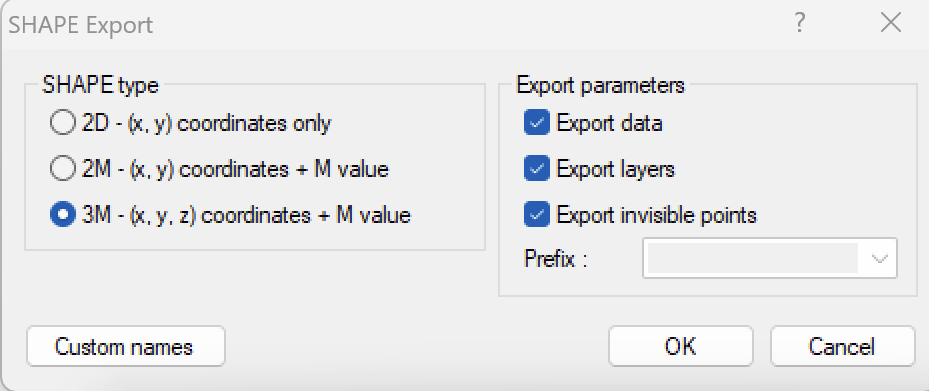
SHAPE type
| Type | Coordinates | When to use |
|---|---|---|
| 2D | X and Y | When only XY geometry is required or permitted |
| 2M | X and Y + M value | When an additional measure value is required |
| 3M | X, Y and Z + M value | When elevation coordinates must also be exported |
A Z value represents an elevation coordinate. An M value is a separate measure value and is not the same as elevation.
Important: Check the requirements of the receiving party before choosing a SHAPE type. Some GIS systems or submission platforms only accept 2D geometry, even when the original drawing contains elevation coordinates.
Export parameters
| Option | Function |
|---|---|
| Export data | Exports linked database tables and their attribute data. |
| Export layers | Organises the output by layer and includes the layer name in the generated filename. |
| Export invisible points | Includes invisible points in the export. |
Use Export data when you want to include attributes stored in database tables linked to drawing objects.
Use Export layers when you want to distinguish the original drawing layers in the exported files.
4. Check the filenames
Click Custom names to see which Shapefiles Pythagoras will generate.
The list displays the output groups based on the selected objects and export settings, including the database table, layer and object type where applicable.
You can edit the proposed filenames in the Filename column.
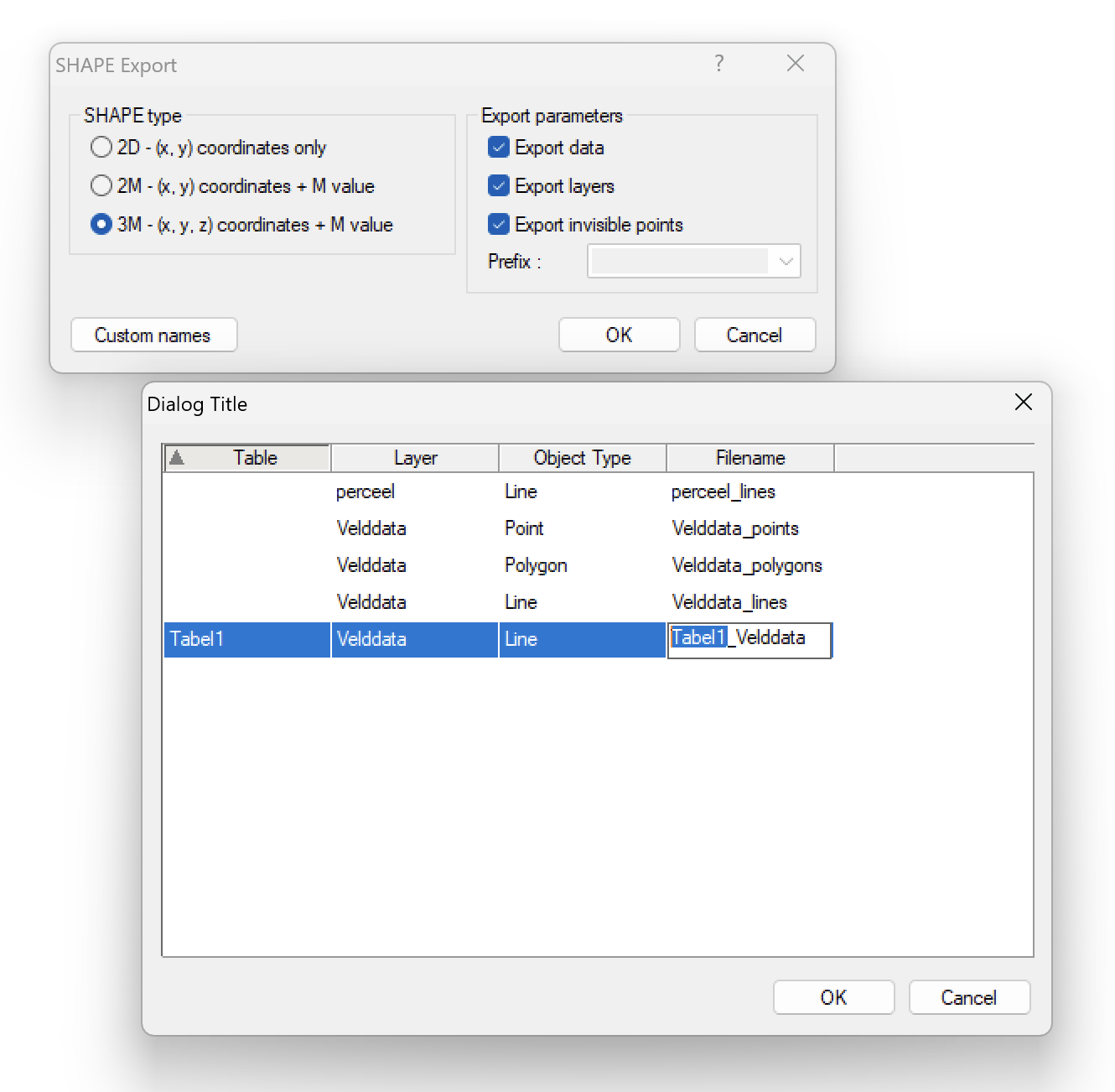
5. Complete the export
Click OK to confirm the filenames, then click OK in the SHAPE Export dialog.
Pythagoras exports the selected objects and returns to the drawing.
The exported files are saved in the destination folder you selected.
Which files are created?
For each Shapefile dataset, Pythagoras generates several associated files: .shp, .shx, .dbf and, when a valid CRS is assigned, .prj.
| File type | Description |
|---|---|
.shp | The geometry (points, lines, or polygons) |
.shx | Index file |
.dbf | Attribute table (layer, color, etc.) |
.prj | Coordinate Reference System description |
Important: Keep the associated files together when sharing the dataset. Sending only the .shp file is generally insufficient for proper data exchange.
Was this article helpful?
That’s Great!
Thank you for your feedback
Sorry! We couldn't be helpful
Thank you for your feedback
Feedback sent
We appreciate your effort and will try to fix the article